A foam mattress is not automatically the coolest, firmest or longest-lasting choice for a Nagpur home. By comparing foam with spring, coir, latex, hybrid and therapeutic designs, then matching construction to your body, room and bed base, you can choose with more confidence and avoid judging a mattress by thickness or price alone.
Key takeaways
- Choose breathable spring or ventilated foam for hot Nagpur bedrooms.
- Match firmness and support to your sleeping position and body weight.
- Compare foam density, ILD, layers and warranty instead of thickness alone.
- Check mattress dimensions, packaging, ventilation and damage before accepting delivery.
How foam, spring, coir and therapeutic mattresses differ
Foam mattress compared with other mattresses in Nagpur depends on the balance you want between pressure relief, movement control, edge support, airflow, bounce, noise and ease of turning. Memory foam and conventional polyurethane foam cushion pressure points and limit partner disturbance, but memory foam can trap more heat and make turning harder.
Latex foam feels springier, moves with you more easily and ventilates better, but costs more and has noticeable bounce.
| Option | Pressure relief and movement | Airflow, bounce and support | Better choice when |
|---|---|---|---|
| Conventional or memory foam | Strong cushioning; low noise and motion transfer | Less airflow; memory foam makes turning harder; edge support depends on construction | You share a bed or need pressure relief |
| Bonnell or continuous-wire springs | Easier movement; more motion transfer | Good ventilation and bounce; weaker individual support and more noise | You prefer a responsive, cooler-feeling bed at lower cost |
| Pocketed coils | Better motion isolation than linked coils | Good airflow, stronger targeted support; coil count alone proves nothing | You want spring movement without as much partner disturbance |
| Hybrid | More cushioning than bare springs; easier movement than all-foam | Ventilated coil core with foam comfort; edge support varies | You want a practical balance for Nagpur heat |
| Coir | Firm, low-sink feel; limited contouring | Quiet and stable but less cushioning and bounce | You dislike sinking or need a firm surface |
| Therapeutic | Depends on the actual support design | The label proves no treatment or comfort result | You can inspect its zones, firmness and pressure distribution |
For a useful mattress types comparison in Nagpur, test your sleeping position and turning effort, not the label. Choose springs for airflow and bounce, coir for firmness, or a therapeutic design only after checking its construction and getting appropriate clinical advice.
Why Nagpur heat changes the foam-versus-spring decision
Nagpur’s April and May heat, with daytime temperatures commonly reaching 40–45°C, makes airflow a practical mattress decision. A close-conforming memory-foam layer holds more body heat than a ventilated pocketed-coil or hybrid core, especially in a room without continuous air-conditioning.
| Option | Heat and airflow | Feel and trade-off |
|---|---|---|
| All-foam memory foam | Least underside airflow; cooling covers, gel and open-cell foam change surface sensation but do not create spring-core ventilation | Strong pressure relief and motion control; can feel warmer and harder to turn on |
| Pocketed-coil hybrid | Coil channels improve ventilation; foam thickness and density still affect heat | More pressure cushioning than bare springs, with easier movement |
| Latex or solid coir | Latex usually allows better surface airflow; coir stays firm and less enveloping | Latex feels resilient and bouncy; coir suits sleepers who dislike sinking |
These mattress options for homes in Nagpur respond differently to monsoon moisture. Keep any mattress level on a ventilated slatted base, following the manufacturer’s maximum slat gap; a solid floor or unventilated board traps dampness underneath and can produce a musty odour or mould.
A washable, breathable protector is preferable when sweating is a concern because it limits sweat, skin oils and stains without sealing in as much heat as a completely waterproof, non-breathable cover. Wash the protector according to its care label, and maintain room airflow during humid weather.
The foam mattress benefits in Nagpur depend as much on that maintenance and base ventilation as on a gel layer or “cooling” label.
Match mattress support to sleeping position, weight and pain points
Choose cushioning and support together: side sleepers need pressure relief without pelvic drop, back sleepers need even lumbar support, and stomach sleepers need a firmer surface to limit sinking.
| Position | Suitable choices | Check before buying |
|---|---|---|
| Side | Memory foam, latex or cushioned hybrid | Shoulders and hips sink slightly; pelvis stays level |
| Back | Medium-firm foam, latex or pocketed-coil hybrid | Lumbar area remains supported without a hard gap |
| Stomach | Firmer foam, coir or supportive hybrid | Hips do not dip below the chest |
Heavier sleepers need stronger support layers than lighter sleepers in the same position. A thick comfort layer alone can compress too far, so inspect the support core and edge stability.
For couples, memory foam offers stronger motion isolation but makes turning harder. Latex, pocketed coils and hybrids allow easier movement, with more bounce and possible sound. Children need a stable, correctly sized surface rather than an excessively soft bed.
For back or joint pain, lie in your normal position and check whether your spine stays level and pressure reduces at the shoulders, hips or knees. A “therapeutic” label is not a diagnosis or a guarantee.
Do not confuse foam density with firmness. Density is stated in kg/m³ and relates more to material consistency and durability; firmness is commonly reported as ILD or IFD. High-density foam is not automatically firm.
These checks reveal the practical foam mattress benefits in nagpur and make any mattress types comparison in Nagpur more useful than a universal firmness claim.
Compare foam specifications instead of trusting thickness claims
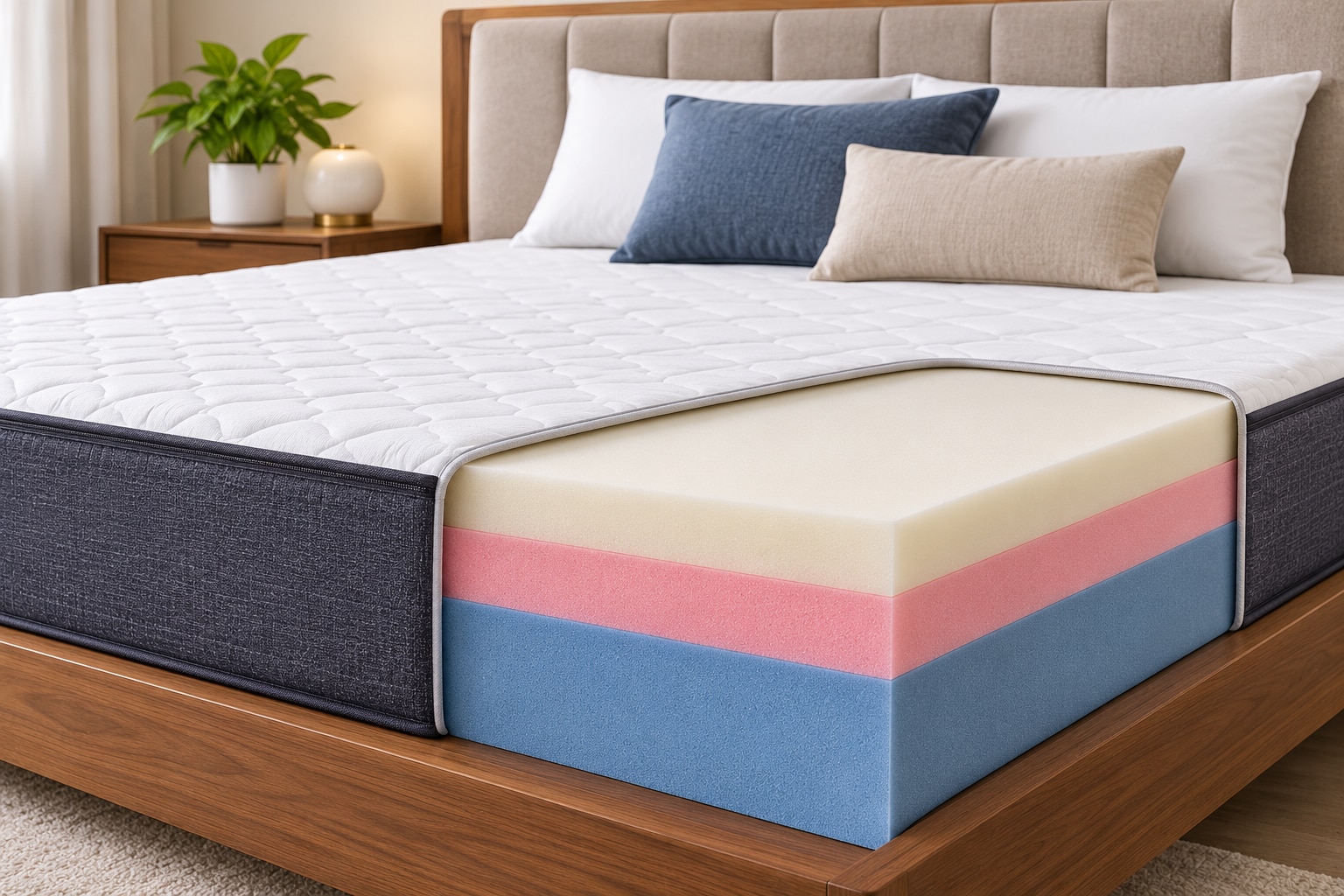
An 8-inch mattress is not automatically better built than a 6-inch one. Ask for the density in kg/m³ and thickness of each major layer: support core, transition layer and comfort layer. Low-density comfort foam can form body impressions sooner, even inside a thicker mattress.
Foam type changes feel and airflow. Confirm whether the layers use polyurethane, high-resilience foam, memory foam, latex or a combination.
| Type | Feel and behaviour | What to check |
|---|---|---|
| Polyurethane foam | Stable, usually economical | Density of the support core and comfort layer |
| High-resilience foam | Easier movement and faster recovery | Resilience claims plus layer thickness |
| Memory foam | Strong pressure relief and low motion transfer | Heat retention and slow turning |
| Latex foam | Springier, cooler-feeling surface | Latex content, firmness and edge support |
| Hybrid foam | Foam cushioning over coils | Coil unit, foam density and total layer thickness |
For a foam mattress compared with other mattresses in Nagpur, lie in your normal sleeping position for several minutes before judging firmness. Check that your shoulders and hips feel cushioned, your pelvis does not sink, and the edge stays firm when you sit and turn.
- Measure the bed frame’s internal length and width.
- Check mattress height against fitted sheets and the headboard.
- Confirm the base’s permitted slat gap.
- Reject a sample that leaves a sagging centre, rolls you toward the edge, causes morning stiffness or traps heat badly.
These checks make mattress options for homes in Nagpur fit the sleeper and bed, not merely the advertisement.
Use a Nagpur buying checklist before delivery and after setup
Ask the supplier for written specifications before you compare mattress options for homes in Nagpur. Record the support-core construction, every foam layer’s density in kg/m³, firmness measurement such as ILD or IFD, cover fabric, removable-cover washing instructions, compatible bed base and maximum slat gap.
| Option | Support and feel | Check before buying |
|---|---|---|
| All-foam | Strong pressure relief and motion isolation; turning can be harder and heat higher | Ask for each layer’s density and thickness |
| Pocketed-coil hybrid | More airflow and easier movement with foam cushioning | Confirm coil unit, foam density and edge reinforcement |
| Spring | Bounce, ventilation and edge support; more partner movement | Ask whether coils are pocketed, Bonnell or continuous wire |
| Coir | Firm, stable surface with little sinking | Check whether its firmness suits your shoulders and hips |
Also confirm the trial duration, return or exchange conditions, and warranty exclusions for sagging. Ask how the seller measures a body impression: specify the load, measurement tool, location and permitted depth.
- Measure the frame’s internal length and width, then check the mattress against it before removing sealed packaging.
- Record the stated dimensions and inspect seams, handles, edges and surface damage.
- Place it on a level, ventilated base, not a solid floor or unventilated board.
- Ventilate compressed foam in a well-aired room before use.
A temporary manufacturing odour can fade; a strong persistent smell, visible damage or failure to expand to the stated size warrants a delivery or warranty complaint. Palak Furnishing Nagpur can help shoppers compare samples while asking these construction and policy questions.
The best choice fits your sleeping position, body weight, room temperature, base and willingness to wash the cover—not simply price or height.
Frequently asked questions
How do foam, spring, coir and therapeutic mattresses differ?
Foam mattresses reduce movement and cushion pressure points. Spring mattresses provide bounce, airflow and edge support. Coir mattresses feel firmer and offer limited contouring. Therapeutic mattresses target specific support or pressure-relief needs, so check the design rather than relying on the label.
Why does Nagpur heat affect the foam-versus-spring decision?
Memory foam can retain more body heat and make turning harder. Spring mattresses allow more airflow, while ventilated foam and breathable covers can reduce heat buildup.
How should you match mattress support to sleeping position and weight?
Side sleepers need pressure relief at the shoulders and hips. Back sleepers need even support through the lumbar area. Stomach sleepers usually need a firmer surface to reduce hip sinking. Higher body weight requires stronger support and durable edge construction.
Which foam specifications should you compare?
Ask for foam density, firmness or ILD, layer thicknesses, core construction, cover fabric, trial terms and warranty exclusions. Total mattress thickness alone does not show durability or support.
What should you check before accepting a mattress in Nagpur?
Confirm the size, model, firmness and invoice. Inspect the packaging, seams, cover, edges and surface for damage. After setup, allow compressed foam to expand in a ventilated room and follow the manufacturer's waiting period before use.
Keywords