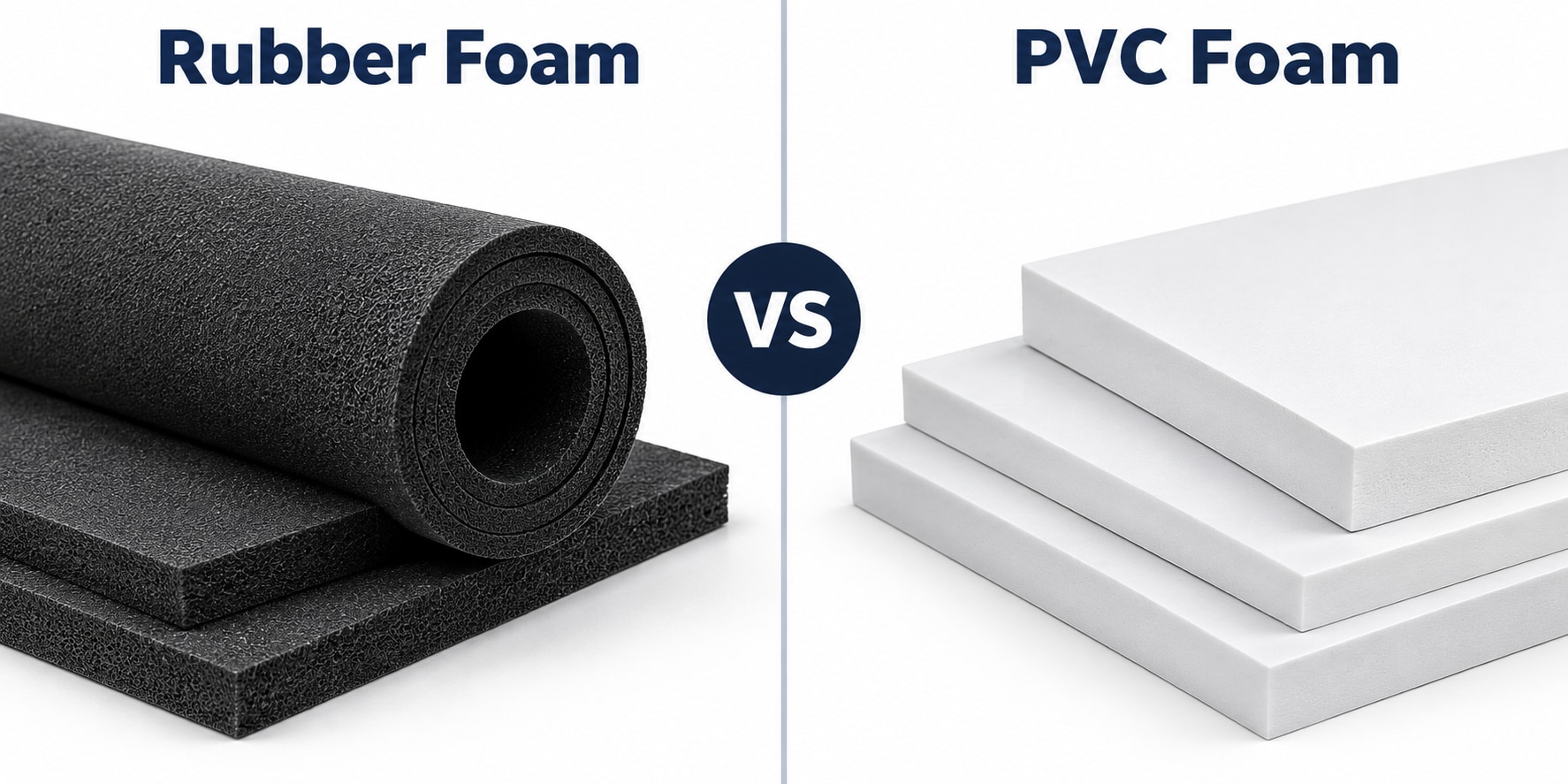
The buying decision starts with a terminology problem: “rubber foam” can mean latex, synthetic rubber, rebonded crumb or rubberized coir, while “PVC foam” can mean flexible cushioning or rigid board. By the end, you will be able to identify the material, compare its performance with measurable tests, match it to each sofa component and specify a sample before placing an order.
Key takeaways
- Confirm the polymer, density, hardness and cell structure before comparing foam.
- Use resilient flexible foam for cushions; reserve rigid PVC for suitable structural applications.
- Measure thickness, compression and clearance instead of judging samples by hand.
- Give suppliers a written specification covering performance, dimensions and service conditions.
Define the Material Before Comparing the Foam
Before comparing foam types for sofa production, identify the polymer and construction: “rubber foam” and “PVC foam” are trade labels, not specifications. A supplier might mean natural-latex foam, synthetic-rubber foam, rebonded rubber crumb, flexible plasticized PVC, or rigid PVC sheet.
| Material | Composition and manufacture | Structure and upholstery implication |
|---|---|---|
| Natural-latex foam | Natural rubber latex, usually molded with a pin-core pattern | Open-cell; springy, resilient and more air-permeable, but absorbs more moisture than closed-cell foam |
| Synthetic-rubber foam | Synthetic elastomer such as SBR or neoprene, molded or cut from a block | Formulation controls resilience, airflow and absorption |
| Rebonded rubber crumb | Shredded rubber pieces bonded and molded with adhesive | Irregular, dense structure; firm support, not the same feel as molded latex |
| Rubberized coir | Coir fibres coated or bonded with latex or rubber | Fibre-based and breathable; commonly used as a firm layer, not homogeneous foam |
| Flexible plasticized PVC foam | PVC polymer softened with plasticizer, then molded or extruded | Usually closed-cell; limited airflow and lower water absorption, useful only for specified constructions |
| Rigid PVC foam sheet or board | Foamed PVC board with much less flexibility | Semi-rigid or rigid panel for backing, trim or structure, not a seat cushion |
Ask for the exact grade, density, thickness and intended upholstery use. Also confirm whether the piece is molded, cut or rebonded, because those processes change cell structure, airflow, water absorption and feel. “PVC foam” alone cannot tell you whether you are buying cushioning or board.
Match Resilience, Firmness and Cell Structure to Sofa Parts
Seats and loose cushions usually suit latex or other rubber foam because springy recovery resists bottoming-out and repeated sitting. Backs and arms carry less load, so softer rubber foam or conventional flexible polyurethane may work; a firm seat grade can make a back uncomfortable.
| Part | Better fit | Reason and warning |
|---|---|---|
| Seat | Latex or resilient rubber foam | Higher fatigue resistance and support; verify load-deflection and compression set. Flexible polyurethane with springs, webbing or fiber remains more common. |
| Back | Soft rubber foam or flexible polyurethane | Comfort needs less load capacity than a seat; avoid a grade that collapses against the frame. |
| Arm | Flexible polyurethane or soft rubber foam | Shape and comfort matter more than extreme resilience. |
| Loose cushion | Latex or high-resilience foam | Recovers after compression; match thickness to the cover and support. |
| Recliner | Flexible foam or molded flexible PVC for a specific design | Use PVC only where its shape, flex pattern or moisture resistance solves a construction problem. |
| Outdoor furniture | Outdoor-rated flexible PVC or protected rubber foam | Closed cells reduce water absorption, but seams and fabric still admit water. Exposed latex faces ultraviolet light, ozone, oils and solvents. |
Rigid PVC foam board is not a seat cushion. It provides backing, panels or structural support and will feel hard, not springy. Confirm that “PVC foam” means flexible, plasticized cushioning foam before approving it.
Latex is not automatically best: it weighs more, costs more than commodity polyurethane and varies with formulation, pin-core design and thickness. The practical rubber foam versus PVC foam for sofa makers in Nagpur comparison is application-specific; rubber foam for furniture makers in Nagpur should be chosen by fatigue, firmness and exposure—not sheet price.
Compare Samples Using Numbers Instead of Hand Pressure
Approve a foam grade from measured data, not from a supplier’s hand squeeze. Request density in kg/m³ together with indentation-force or load-deflection values; density does not equal firmness. State the test method, specimen size and conditioning period before comparing quotations.
| Metric | Request | What it proves |
|---|---|---|
| Density | kg/m³ for the current batch | Material mass, not firmness |
| Firmness | Indentation force or load-deflection under ISO 3386-1 | Force required at stated deflection |
| Thickness | Actual thickness and declared tolerance | Cutting and finished-height consistency |
| Compression set | Percentage and conditions under ISO 1856 | Permanent deformation after compression |
| Recovery | Time to regain specified thickness | Whether the cushion rebounds promptly |
| Strength | Tensile strength, elongation and tear strength where relevant | Resistance to stretching and edge damage |
Compression set is not repeated-sitting fatigue: a foam can pass one permanent-deformation test yet fail after thousands of loading cycles. Ask for a fatigue or repeated-load result for heavy-use seating. This distinction matters when comparing pvc foam for sofa manufacturing in nagpur, where heat can also change hardness, odor and surface feel.
Use the same sample and sequence every time:
- Measure length, width and thickness at marked points.
- Compress the same area by the stated method, then record recovery time and final thickness.
- Inspect for cracking, splitting or tackiness; check odor and response to moisture.
- Cure the intended adhesive, then test the complete foam, adhesive, fabric and frame combination for bond strength, tack, odor and color transfer.
Calculate Thickness, Clearance and Real-World Service Conditions
Start with the finished geometry, not the supplier’s standard sheet. Measure the frame cavity and the old cushion cover separately; the cover reveals sewn dimensions, while the cavity reveals the space available above the frame, springs or webbing.
Select thickness and firmness from the intended finished seat height, arm and back proportions, and the support required. More thickness can improve comfort and support, but it also raises the seat, reduces clearance, and can make arms or backs look crowded. Choose firmness from load-deflection data, not hand pressure.
- Measure cavity length, width and depth at several points; record the smallest usable dimension.
- Subtract intended foam compression and the cover allowance from each finished dimension.
- Add a controlled cutting allowance only where the cover design requires it; do not hide measurement errors in oversized foam.
- Record length, width, thickness and grain or cell orientation for every piece, including seat, back, arm and edge components.
Build one representative prototype with the intended cover, batting, adhesive, springs or webbing, and frame. Repeat sitting and edge-loading trials, then check seat height, bottoming-out, recovery, cover tension and movement.
In Nagpur, store latex away from sunlight and ozone sources. Never leave PVC in a sun-heated vehicle or unventilated hot warehouse. Request heat-aging results or the service-temperature range for the exact PVC grade, because heat can change hardness, odor, surface feel and plasticizer behaviour.
Turn the Comparison into a Supplier Specification
Approve a batch only against a written specification. A sheet that feels right today can vary in firmness, thickness, odor or recovery between production lots.
| Item | Ask the supplier for | Reject or hold when |
|---|---|---|
| Polymer type | Natural latex, synthetic rubber, rebonded rubber, flexible plasticized PVC, or rigid PVC | “Rubber” or “PVC” is the only description |
| Manufacturing method | Molded, cut, laminated or rebonded process | The process and cell structure are unknown |
| Application | Separate grades for seat, back, arm and edge use | One grade is quoted for every component |
| Current batch sample | A sample cut from the present production batch | The sample is old, warped, tacky or smells strongly |
| Technical data sheet | Density, load-deflection, compression set, tensile, elongation and tear data | Values lack units or test methods |
| Tolerances | Declared length, width, thickness and density limits | No acceptance range is stated |
| Test conditions | ISO 3386-1 or ISO 1856, conditioning, temperature and loading details | Quotations use incomparable tests |
| Supply terms | Minimum order quantity and lead time | The batch cannot support your production schedule |
| Packing and storage | Packing date, ventilation, stacking limits and temperature or sunlight instructions | Packaging date or storage guidance is missing |
Test latex, PVC, fabric and the frame together with the chosen adhesive after curing. Check odor, bond strength, surface tack and color transfer; incompatible solvent adhesives can attack PVC plasticizers or degrade latex.
A foam supplier for sofa makers in Nagpur, such as Palak Furnishing Nagpur, becomes useful when you bring a drawing, old cover measurements, and seat, back, arm and edge specifications—not a request for generic “rubber” or “PVC” foam.
Choose by verified performance for the specific sofa component, never by sheet price alone.
Related products
 | SOFA FOAM Palak Furnishing - Excellent foam to use for sofa cushions. Varieties include PU foam, HR foam, high density foam & low density foams are available... View product → |
 | SLEEPWELL FOAM FOAM Furniture Cushioning An innovative range of Sleepwell Furniture Cushioning products that promise lasting comfort, support and durability. |
Frequently asked questions
What should sofa makers confirm before comparing rubber foam with PVC foam?
Confirm whether the product is natural-latex foam, synthetic-rubber foam, rebonded rubber crumb, flexible plasticized PVC or rigid PVC sheet. Then request density, hardness, resilience and cell-structure details.
Which foam properties matter for different sofa parts?
Match resilience and firmness to the part. Seat cushions need recovery after compression, while back cushions, armrests and padding require different firmness and thickness. Rigid PVC is not a direct substitute for flexible cushion foam.
How can you compare foam samples more reliably than hand pressure?
Record measurable values such as density, thickness, compression firmness and recovery. Compare samples at the same dimensions and under the same load rather than relying only on touch.
What should you calculate before selecting foam thickness?
Check the finished thickness, upholstery allowance, frame clearance, compression under load and the sofa’s temperature, moisture and usage conditions. A thicker sample is not automatically the better choice.
What information belongs in a foam supplier specification?
State the polymer, foam construction, density, firmness, resilience, dimensions, tolerance, intended sofa part and service conditions. Include test methods or sample-based acceptance criteria when available.
Related products
 | SOFAFABRIC PALAK FURNISHING :- Different types of Sofa fabrics include cotton, linen, wool, leather, hemp, silk, polyester, polypropylene, rayon, and nylon are... View product → |
 | comphartable sitting with resionable price. View product → |
Keywords