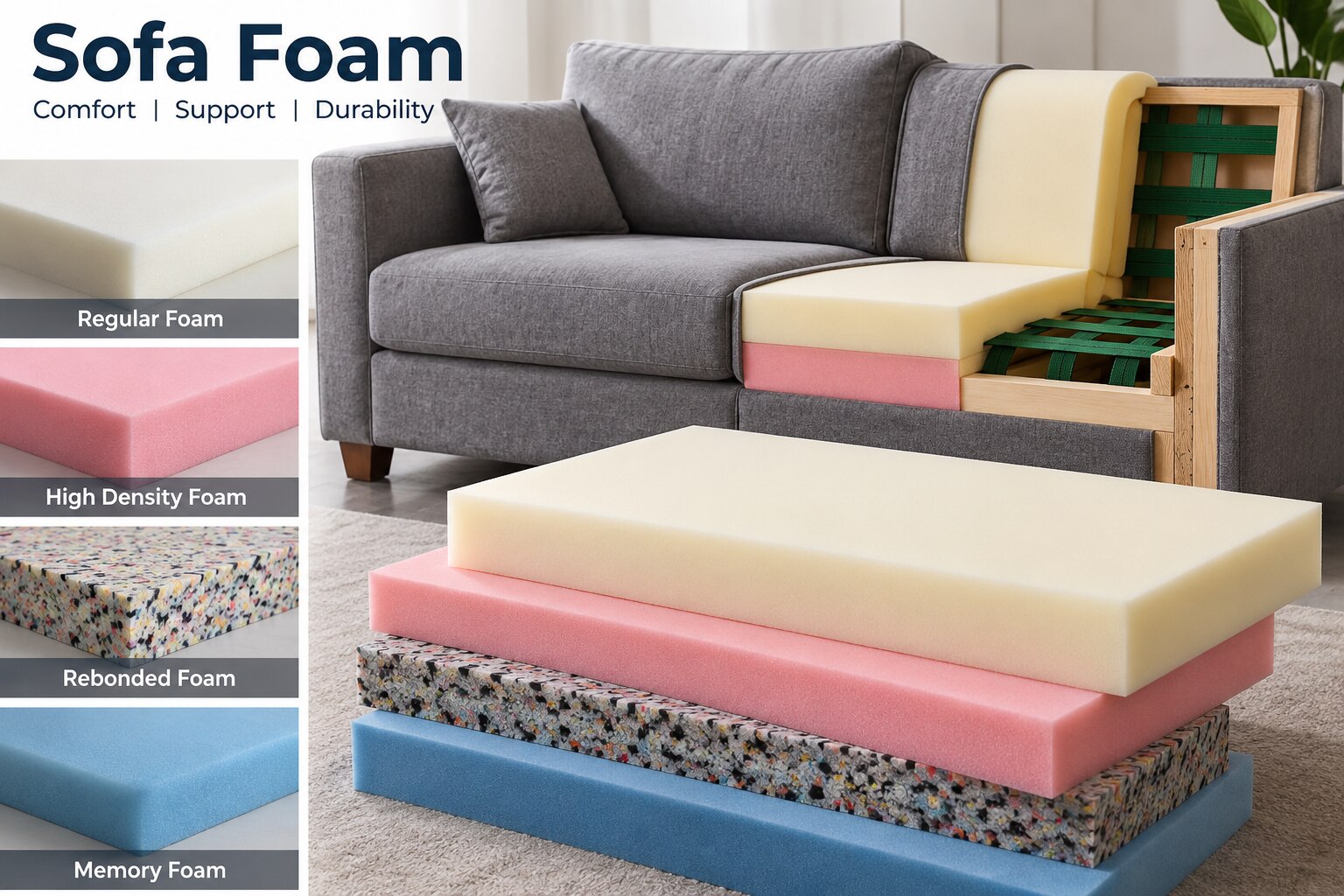
A sofa-foam quotation can cover only a foam slab, or it can include cut-to-size pieces, trimming, delivery and fitting support. You will be able to measure your cushions, specify the right material and check whether the quoted package includes the layers and services your sofa actually needs.
Key takeaways
- Ask whether the quotation covers foam alone, cutting, shaping or a complete cushion assembly.
- Measure cushion length, width and thickness at several points before ordering replacement foam.
- Match seat, back and armrest foam to their different support and flexibility needs.
- Check foam dimensions, density, quantity, delivery timing and replacement terms before accepting the order.
What should a sofa-foam quotation include?
A quotation can mean foam alone or a complete cushion assembly, so ask which one you are buying. A full slab is uncut stock; a cut-to-size piece is trimmed to your dimensions; a ready-shaped cushion has profiling, contouring or edge shaping already completed.
| Option | What the quote means | Confirm before comparing |
|---|---|---|
| Full slab | One large, uncut foam sheet | Grade, density, firmness, thickness and slab dimensions |
| Cut-to-size piece | A measured piece cut from a slab | Cutting charge, finished dimensions and replacement policy |
| Ready-shaped cushion | Foam shaped for a particular cover or profile | Whether cover, batting and fitting are included |
Confirm these extras separately:
- Cover fabric, batting or Dacron, adhesive and trimming
- Delivery to your address, installation and fitting assistance
- Webbing, springs, plywood, jute and other support layers
Those support layers belong to the wider sofa build-up, not automatically to the foam order. A quotation should also state whether tax and delivery are included, and whether a wrongly cut piece can be replaced. Once cut, returns are often restricted.
Foam is sold by slab, cut piece, kilogram or cubic foot. A per-piece price means little until grade, density, firmness, thickness and dimensions match. Record these sofa-foam purchase details in Nagpur, including the cutting list and warranty terms; density alone does not prove durability.
How do you measure an existing sofa before ordering foam?
Turn the old sofa into a cutting list, not a guess based on the frame’s outside dimensions. Compressed or misshapen foam can give a false size, so measure each piece at several points before ordering.
1. Measure every seat cushion’s finished length, width and thickness. Record the number of cushions and the gap between them, then note whether each cushion sits inside a removable cover.
2. Measure each back cushion separately: height, width and finished thickness. Do not assume the back matches the seat; a sloping back, recessed frame or loose back pad changes the required shape.
3. Check the profile from every side. Record tapered edges, rounded corners, angled ends and any contour direction. Photograph the old piece beside a tape measure to show details a number cannot capture.
4. Repeat the measurements for arm pads and side panels. Your list should identify each seat, back, arm and side piece, its quantity, finished length, width and thickness, plus its contour direction.
5. Ask the upholsterer—not only the foam seller—whether a tight cover needs a small oversize allowance or seam clearance. Exact frame dimensions can leave a cushion looking loose; adding material blindly can stop the cover fitting.
For a new sofa, order by individual piece rather than requesting one generic sofa-size sheet. Slabs are cut to order, and the useful comparison for sofa foam types and sizes in Nagpur is a complete, dimensioned list with the correct profile.
Which foam specification matches each sofa part?
A sofa seat needs resilience; a back cushion needs controlled softness and easy shaping. For sofa foam buying information in Nagpur, request the grade, density in kg/m³, firmness or compression-force-deflection value, and compression set separately.
| Option | What it means | Best furniture use |
|---|---|---|
| Conventional PU | Economical, flexible foam with straightforward recovery | Occasional-use chairs, armrests, backs and budget sofa seats |
| HR PU | More resilient foam that recovers faster after repeated loading | Daily-use seats, benches, recliners and firm back cushions |
| Rebonded foam | Dense, heavy, firm foam made from compressed foam scrap | Foundations, hard-wearing benches, mattress support and firm seat bases |
| Memory foam | Slow-recovering, heat-sensitive comfort material | Thin comfort layers on seats or mattresses, not a complete structural seat |
A back cushion often uses a softer or lower-firmness grade than a seat because it supports the body without carrying full sitting load. Use HR PU for a frequently used seat, conventional PU where price and occasional use matter, and rebonded foam beneath a softer layer when you need firm support.
Memory foam alone can feel slow to recover and harder to rise from in Nagpur’s warm climate.
Density indicates mass and cell structure, not softness; two foams with the same density can feel different. Do not treat labels such as 28, 32, 40 or 45, colour or “premium” as complete specifications. Ask which results support the claim under ISO 845, ISO 3386-1, ISO 1856 or ASTM D3574.
What thickness and construction does each cushion need?
Start with the frame, not a standard sheet: 100–150 mm suits many sofa seats, but the correct thickness depends on seat depth, plywood, webbing, springs or jute support, user load and cover design. These figures are starting points for discussion, not a substitute for measuring the frame.
| Cushion or use | Practical starting thickness | Construction guidance |
|---|---|---|
| Sofa seat | 100–150 mm | Firm foundation with a softer comfort layer |
| Back cushion | 75–125 mm | Softer foam can work because it carries less load |
| Bench | 75–125 mm | Check the unsupported span and frame depth |
| Recliner seat | 75–125 mm | Confirm clearance during movement |
| Occasional-use chair | 50–100 mm | Avoid excess thickness that changes the seat height |
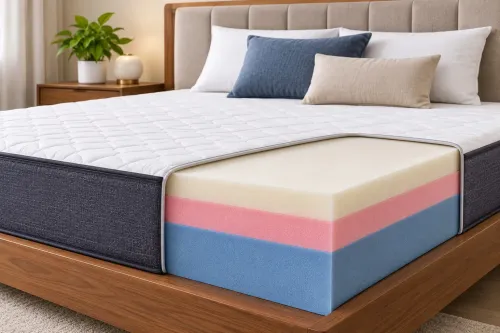
Plywood, webbing, springs or jute carry the base load. Foam supplies cushioning, while batting or Dacron smooths the shape beneath the fabric cover. Rebonded foam, made from compressed foam scrap, gives a dense, firm foundation; place a softer comfort layer above it instead of putting a hard slab directly under thin upholstery.
Request a sample or offcut before ordering. Sit on it and check recovery after compression, edge collapse, surface cracking, uneven density and odour. Wet open-cell foam must dry fully before re-covering; trapped moisture creates staining, smells and microbial growth.
For reliable sofa foam buying information in Nagpur, record the chosen grade and thickness on the invoice, then verify the frame dimensions with the upholsterer. Density alone cannot predict comfort or service life.
How can you check the order, quantity and supplier service?
Compare a quote from a foam supplier for sofa makers in Nagpur only after the grade, density, firmness, thickness, dimensions, cutting charge, tax and delivery terms match.
| Quote basis | What to verify | Common mistake |
|---|---|---|
| Full slab | Slab length, width, thickness and usable area | Comparing its price with a single cut cushion |
| Cut piece | Each finished dimension, quantity and trimming charge | Assuming every piece has the same rate |
| Kilogram or cubic foot | Density, calculated volume and freight basis | Treating a low unit price as a lower total cost |
Calculate quantity as length × width × thickness, using the same unit for all three measurements. One cubic foot equals 0.0283168 cubic metres. For an approximate weight check, multiply volume in cubic metres by the stated density in kg/m³; cutting waste and tolerances can change the invoiced weight.
Before accepting the order, use a sample or offcut and check:
- Thickness at several points
- Square, straight edges
- Tears, crushed areas or surface cracks
- Strong odour, moisture or uneven density
- Recovery after compression
Ask for a written replacement policy before cutting, because returns are often restricted once a slab becomes a custom cut. The invoice must name the foam type, density, firmness, quantity and every seat, back, arm or side-panel dimension.
Palak Furnishing Nagpur is worth considering when you need to discuss a cut list, supporting materials, delivery or fitting, but retain the same written sofa foam purchase details in Nagpur and perform these checks before acceptance.
Related products
 | SOFA FOAM Palak Furnishing - Excellent foam to use for sofa cushions. Varieties include PU foam, HR foam, high density foam & low density foams are available... View product → |
 | SLEEPWELL FOAM FOAM Furniture Cushioning An innovative range of Sleepwell Furniture Cushioning products that promise lasting comfort, support and durability. |
Frequently asked questions
What should a sofa-foam quotation include?
Ask the supplier to state whether the price covers a full slab, cut-to-size foam or a ready-shaped cushion. The quotation should also identify dimensions, foam specification, quantity, cutting or profiling charges, delivery timing and replacement terms.
How do you measure an existing sofa before ordering foam?
Remove the cover and measure the foam length, width and thickness. Measure in more than one place, record the largest required dimension, and note tapered corners, rounded edges, contours and any compression or sagging.
Which foam specification matches each sofa part?
Seat cushions need firmer, resilient foam for repeated loading. Back cushions need softer, more flexible foam for comfort. Armrests and decorative sections need foam selected for shape retention, edge forming and the available space.
What thickness and construction does each cushion need?
Use the old cushion and the cover dimensions as starting references, then account for the frame, batting, upholstery allowance and desired seat height. Choose a single slab, layered construction or shaped foam according to the cushion design.
How can you check the order, quantity and supplier service?
Compare the delivered pieces with the written dimensions, count, foam specification and agreed cutting or shaping work. Check for damaged edges, incorrect profiles and short quantities before fitting, and confirm how the supplier handles errors or replacements.
Keywords